 |
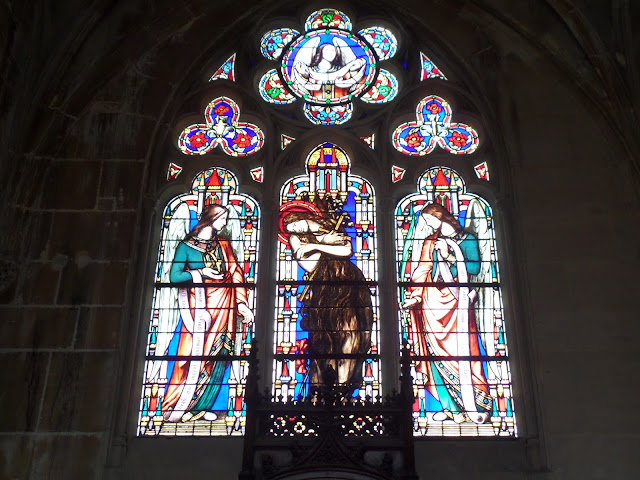
The central panel of this stained glass window depicting Mary Magdalene at St. Germain L'Auxerrois wasn't installed until the 15th century, so Christine wouldn't have know it, but it echoes the 13th century statue of Mary of Egypt on the exterior.
|
One could spend
weeks visiting the churches of Paris. But on previous trips, I was
happy to visit only Notre Dame. I’m not interested in the churches in the same
way some visitors to France are. I can
appreciate their beauty, but it’s always a challenge for me to know that the
stones of the churches were delivered on the backs (literally and figuratively)
of the poor.
Even so, churches
are at the center of medieval life, and there are a number of churches in Paris
where Christine might have worshiped. We
know that she spent time in a small Queen’s Chapel at St. Pol because she
writes about the interior decoration with wonder and affection. On this trip, I wanted to go into the major
churches of her time to see what she might have seen.
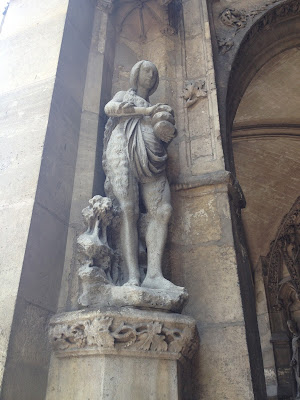 |
This Mary of Egypt statue was installed in the 13th
century, so it has stood on the church portal since
before Christine was born.
|
I explored a
number of churches, and the iconography and stained glass in each was
impressive, but walking up to St. Germain L’Auxerrois I got a sense that
something about the church was different.
Most churches have Mary somewhere on the portal, but this church had a
number of female saints, on some portals there were more female saints than
male ones.
Particularly
intriguing was the sculpture of a woman who didn’t seem to be wearing any
clothes. Her body was covered by her
sculpted hair. She held a small drape and seemed to be carrying three big stones
or loaves of bread. I’m not Catholic,
but I’ve been interested in the Middle Ages for a long time, so I’m familiar
with many saints. This one I did not
know. I was sharing a flat with my
friends, both of who are Catholic, but when I asked them later, neither of them
were familiar with a naked female saint.
Inside, the images
of women continued. Several windows in, I found another naked woman covered
only by her hair—no drape, no rounded objects--just hair through which there
was a titillating bit of skin around her belly button.
It didn’t take much
research to discover that both of the women were named Mary. Both were reputed
to be prostitutes before their conversions. It was a regular medieval practice
to depict fallen women without their hair, so you may have already guessed that
one of these women, the one in stained glass inside, is Mary Magdalene.
The other saint
is Mary of Egypt, a prostitute who converted and spent 40 years of penance
alone in the desert. She took only three
loaves of bread with her. The only contact with people she had was with a
priest before her death who gave her the host and consecrated her burial a year
later.
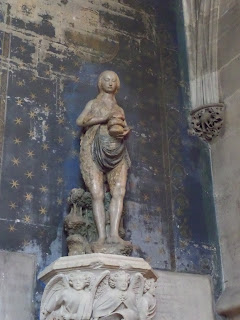 |
Another Mary of Egypt statue, the background
resembles St. Chappelle, but I'm not sure where
I took this picture. Anyone know? |
If Christine
visited this church, she might have been reminded of, as I was, the particularly
conflicted role of women in church culture.
There are many female saints, many depicted in honor on the portals and
windows of churches, yet it was a common practice for learned church men to complain, quite loudly, about women’s more sinful natures.
In her argument
about The Romance of the Rose and
eventually in her City of Ladies and
the Treasure of the City of Ladies,
Christine brings worthy female models to our attention as an argument against
the widespread disregard for women.
Indeed, she mentions both Mary Magdalene and Mary of Egypt in her Treasure of the City of Ladies.
Visiting
churches allowed me to read the texts of Christine’s day. The statues and windows aren’t just ornaments
on a medieval church, they are the Bible come to life, the lessons and stories
that are intended to guide the lives of God’s people, most of whom would not be encouraged to read the Bible even if they could.
The church still
maintained strict access to interpretation in the Middle Ages, and with windows and statues they could highlight the stories and values they wanted
parishioners to attend to. These
values and stories could be set by the powerful abbotts and clerics who worked
with the stone masons and architects to design not just the churches but also
their ornamentation.


