Showing posts with label paris. Show all posts

Thursday, April 14, 2016

Medieval France: Ste. Chapelle

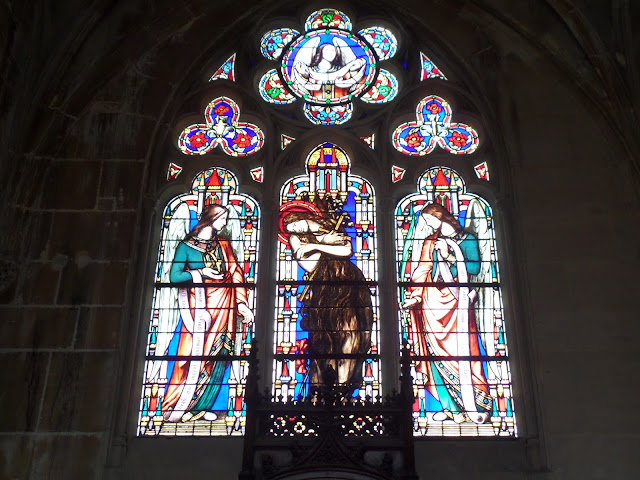
Ste. Chapelle's tall windows.

Though Ste. Chapelle isn’t from the period of history I’m studying, it’s possible, perhaps even likely, that Christine worshipped here at some time or was at least aware of it.  The chapel took Henri III’s breath away.  Others must have understood that it was a gem.  Besides which, the reliquaries that were housed here would have made it interesting to any religious person in the middle ages.

I’m glad I made the trip.  You enter on the ground floor.  Even at that level, the beauty is overwhelming.  I almost missed the staircase to the top floors.  It wasn’t obvious, and I hadn’t read anything about St. Chapelle before I went.  But I saw people walking up the stairs, so up I went.  Breathtaking is probably too mild a word to describe St. Chapelle.  From the beautiful tiled floors, the windows rise up 139 feet into a vaulted ceiling painted with stars.

If you have a chance to see a concert in Ste. Chapelle, go.  
This performance was Bach's Cello Suites, some of my 
favorite music.
If you’ve visited old churches in France, you may be used to the uniform grey of the stone and the niches.  In reality, the medieval church was brightly painted, outside and in, St. Chapelle’s colors have been restored, and they add to its magnificence. 

I returned to St. Chapelle a second time to hear three of Bach’s Cello Suites.  It’s common in Paris through June and July to host musical events in the famous churches.  And why not, the acoustics are wonderful.  Plus it’s a wonderful excuse for tourists to spend time in a church without having to practice a religion.


Sitting in St. Chapelle, I had time to appreciate things other than the windows.  There are five angels carved over the chancel, and I spent much of my time staring at them.  Also as I sat wondering where the reliquaries the Chapelle had been built for were kept, I discovered wells and niches in the walls that I hadn’t noticed when my neck was craned and my eyes were gazing upwards. 

Thursday, March 17, 2016

Medieval Paris: A Fortress Uncovered

The remnants of the Medieval Louvre uncovered during a structrual 
excavation.  Now, this section is the start to the "highlights" tour.
I’ve been to the Louvre twice, so I didn’t feel a pressing need to stare with hundreds of people at the admittedly beautiful artwork there.  Still, I went to the Louvre this visit with a very specific task in mind.  In the Sully wing of the Louvre, an exhibit on the history of the museum culminates with displays from the architectural dig that the museum carried out in order to determine how much more support was needed for construction they planned to undertake. (That construction is a ridiculous mall, by the way, but that’s for another post.)

Included at the end of the exhibit are items that were found
during the excavation.  
The Louvre was important in King Charles time because even when he moved to St. Pol, he kept his library and his treasure at the Louvre in the old Falconry.  King Charles’ library housed over 971 volumes at his death, many of those volumes finely illuminated manuscripts and translations of Greek and Roman philosophers and thinkers.

When the Louvre opened as a museum in 1793, it was not Charles Louvre, but the lavish 15th century building built by Francis I on the destroyed foundation of the Medieval palace.

The current exhibit highlights the Medieval Louvre, uncovering its secrets and providing a glimpse into the king’s fortress.  To make it more appealing a contemporary installation of neon words projected onto the ancient walls breaks up the looming walls and towers.  But the neon wasn’t necessary for me.  I found walking by the towers that Christine walked past inspiration enough.  Here’s the beginning of a poem, “Coming Home,” that I wrote after my visit.


Coming Home


Tourists bustle by. Children sit
impatiently before their teachers.
One asks if there were alligators in the moat.
Around me, a dozen languages
hurry through this dull start
to their highlights’ tour. They’ll rush
from here to the Mona Lisa,
the Vitruvian man,
the winged victory of Salamachus.
I’ll stay here and walk the ramparts,
immersed in (her)story.


The exhibit was crowded with children when I was there. Yes, one really
did ask if there were alligators in the moat.


Friday, February 19, 2016

Medieval Paris: Female Saints at St. Germain L’Auxerrois


The central panel of this stained glass window depicting Mary Magdalene at St. Germain L'Auxerrois wasn't installed until the 15th century, so Christine wouldn't have know it, but it echoes the 13th century statue of Mary of Egypt on the exterior.
One could spend weeks visiting the churches of Paris. But on previous trips, I was happy to visit only Notre Dame. I’m not interested in the churches in the same way some visitors to France are.  I can appreciate their beauty, but it’s always a challenge for me to know that the stones of the churches were delivered on the backs (literally and figuratively) of the poor.

Even so, churches are at the center of medieval life, and there are a number of churches in Paris where Christine might have worshiped.  We know that she spent time in a small Queen’s Chapel at St. Pol because she writes about the interior decoration with wonder and affection.  On this trip, I wanted to go into the major churches of her time to see what she might have seen.
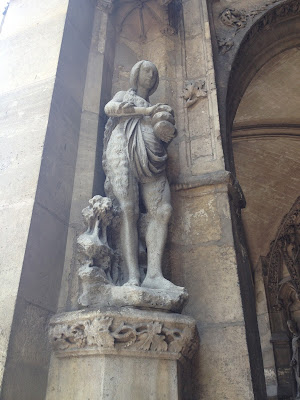
This Mary of Egypt statue was installed in the 13th 
century, so it has stood on the church portal since
before Christine was born. 
I explored a number of churches, and the iconography and stained glass in each was impressive, but walking up to St. Germain L’Auxerrois I got a sense that something about the church was different.  Most churches have Mary somewhere on the portal, but this church had a number of female saints, on some portals there were more female saints than male ones. 

Particularly intriguing was the sculpture of a woman who didn’t seem to be wearing any clothes.  Her body was covered by her sculpted hair. She held a small drape and seemed to be carrying three big stones or loaves of bread.  I’m not Catholic, but I’ve been interested in the Middle Ages for a long time, so I’m familiar with many saints.  This one I did not know.  I was sharing a flat with my friends, both of who are Catholic, but when I asked them later, neither of them were familiar with a naked female saint.

Inside, the images of women continued. Several windows in, I found another naked woman covered only by her hair—no drape, no rounded objects--just hair through which there was a titillating bit of skin around her belly button.

It didn’t take much research to discover that both of the women were named Mary. Both were reputed to be prostitutes before their conversions. It was a regular medieval practice to depict fallen women without their hair, so you may have already guessed that one of these women, the one in stained glass inside, is Mary Magdalene.

The other saint is Mary of Egypt, a prostitute who converted and spent 40 years of penance alone in the desert.  She took only three loaves of bread with her. The only contact with people she had was with a priest before her death who gave her the host and consecrated her burial a year later.
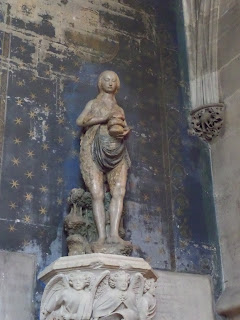
Another Mary of Egypt statue, the background
resembles St. Chappelle, but I'm not sure where
I took this picture.  Anyone know? 
If Christine visited this church, she might have been reminded of, as I was, the particularly conflicted role of women in church culture.  There are many female saints, many depicted in honor on the portals and windows of churches, yet it was a common practice for learned church men to complain, quite loudly, about women’s more sinful natures.

In her argument about The Romance of the Rose and eventually in her City of Ladies and the Treasure of the City of Ladies, Christine brings worthy female models to our attention as an argument against the widespread disregard for women.  Indeed, she mentions both Mary Magdalene and Mary of Egypt in her Treasure of the City of Ladies.

Visiting churches allowed me to read the texts of Christine’s day.  The statues and windows aren’t just ornaments on a medieval church, they are the Bible come to life, the lessons and stories that are intended to guide the lives of God’s people, most of whom would not be  encouraged to read the Bible even if they could. 

The church still maintained strict access to interpretation in the Middle Ages, and with windows and statues they could highlight the stories and values they wanted parishioners to attend to.  These values and stories could be set by the powerful abbotts and clerics who worked with the stone masons and architects to design not just the churches but also their ornamentation.


Monday, February 8, 2016

Medieval Paris: the Clocks of Charles V, the Wise

Charles V was passionate about time. Christine mentions the very strict schedule he kept in her biography of him The Book of the Deeds and Good Character of King Charles V, the Wise. The clocks he had built in Paris are a testament to that passion.

The clock at the corner of the Concierge on the Ile de la Cite in Paris was the first public clock in Paris.  Built at Charles V's direction, it was installed around 1370.   The clock that remains doesn't maintain the exterior or the workings of the original clock. Still, its presence makes it notable for those looking for remnants of Paris in the Middle Ages.  The clock was designed by Micheal de Vick, who introduced a mechaninsm to slow the chain as the weights that ran the clock lowered.  It was the first mechanical clock. 

Charles V also had a clock installed at the donjon at Vincennes and in the Louvre.  And many historians have reported that he decreed that the churches regulate the tolling of their bells by the clocks.  

Even so the watch on your wrist, the clock in your home, even the little alarm clock that you wind each night beside your bed have de Vick’s clock and Charles V's vision to thank.

Wednesday, February 3, 2016

Medieval Paris: The Cluny Museum

The Cluny from outside the walls.
The first time I went to the Cluny, I went for the Unicorn Tapestries.  The next time, I went for the gardens.  This time, I was searching for everyday medieval objects.  In each case the Cluny has more than fulfilled my expectations. 

A reliquary, in this case a golden foot intended to hold
the foot bones of a saint.
The gardens were closed this time, but I ate lunch in a little garden off the side of the museum.  Though it wasn’t specifically medieval in its construction and design, it still allowed me a bit of quiet in the middle of a seven-mile day.  The  Unicorn Tapestries have a delightful new room.  Before, I was concerned about the fading of the tapestries, and the new room uses diffused light to keep the rich reds and deep blacks of the Unicorn Tapestries from continuing to fade. 

What draws me again and again at the Cluny are the reliquaries. I remember being disappointed on my first trip there that they no longer held the hair, toenails, bones, or other physical objects connected to the saints the were created to hold, but the care that has been taken with the containers speaks to a devotion, fascination, and faith that I still admire. 

Board games from the 14th century.
I spent a lot of time in the everyday objects room, fascinated by the combs and buttons in one exhibit and by the playing cards and dominoes in another. 


I can’t imagine a visit to Paris without the Cluny.  Next time, hopefully I’ll be able to eat my Nutella and baguette in the Museum gardens.