Sunday, March 6, 2016

Resource Sharing: Linda Ashman's Dialogue Manuscripts

If you didn't sign up for ReFoReMo this year, put in on your calendar for 
next year.  Only five days in and I've learned so much.  I've been so inspired
that I've already written this month's 12 x 12 draft.  Great stuff.  Highly
recommended.
I'm participating in Read for Research Month (ReFoReMo) this year.  I'm reading books I may never have found otherwise and being inspired by writers I love.  I'm also learning some new tricks that will help me bring some projects that have been in my head for a while into the world.  I love ReFoReMo and I'm so thankful to Carrie Charley Brown and Kirsti Call for bringing this fun challenge into the world.

This is the first part of the first page of Linda Ashman's picture book 
No Dogs Allowed.  You'll find the rest of the manuscript at the bottom 
One of the wonderful resources I've found is from the author Linda Ashman.  She introduced participants to the idea of a dialogue story.  I love these stories.  However, I'm not an illustrator, so I've felt as if this type of story was beyond me. (Picture book writers are frequently warned about not including too many illustration notes.)  Linda directed us to the bottom of her webpage where she has writer resrouces, including her manuscript submissions for four of her dialogue stories.  Yowzah.  Yippee.  I'm a huge fan of model texts.  I'm so thankful that Linda generously shared these files with us.  Now, in addition to being able to write the pictures I've been seeing in my head, I'm also inspired to revise an exisiting manuscript into a dialogue story--the story it has wanted to be all along.

Thank you Carrie, Kirsti, and Linda for helping me learn new tricks.

Wednesday, March 2, 2016

Medieval France: the Donjon (Dungeon) at Chateau Vincennes

The central structure is the donjon at Vincennes.  You can see the students looking into the now dry moat that stands behind the low front wall.  
Just as Charles had a clock in what was once his palace in Paris, he also built one in his fortress at Vincennes.  In her biography, Christine writes about the importance Charles V placed on his daily schedule. Charles was a thoughtful and practical man.

In Vincennes, he created a fortress with layers of protection.  He included, behind the fortified walls in the donjon, a floor in the inner tower that would provide for all his needs--physical, spiritural, material, and intellectual.  His private floor contains a small chapel, a lavatory, his treasures room, a public meeting space, and private meeting spaces including a small office for his secretary and a private study. This in a tower that’s built to withstand a siege. 

The donjon at Vincennes is the tallest remaining fortified tower in Europe.  Much has changed at Vincennes over the years--including the addition of a lovely chapel and modernized facilities for the French army that occupies a part of the compound--still, an ancient air remains. 

The coumpound provides an interesting study in the water supply for an enclosed compound without a source of running water. On the site of the old royal quarters where the queen, the royal children, and the servants lived is an old well with an aqueduct system to supply water to different parts of the building.  Advanced plumbing for a fourteenth century structure.

I hadn't planned to visit Vincennes, but what I found there, including a lovely bookshop, was well worth the trip out of town. The Marquis de Sade and the Man in the Iron Mask are some of the famous prisoners held in the cell at the base of the dungeon. 


Tuesday, February 23, 2016

Resource Sharing: Reading for Research Month

As part of my 1,000 picture book challenge, I’ve also signed up for ReFoReMo.  This challenge, co-founded by Carrie Charlie Brown and Kirsti Call, invites picture book writers to explore the form in depth with mentor texts, guest chats and posts, tools for examining mentor texts, and general advice to would-be picture book writers.

The reading list for the first three weeks was posted today, and though I’ve already read a number of books on the list, there are enough new ones on the list that I’m already excited to find more writers and illustrators to fall in love with. 

The challenge includes both fiction and non-fiction picture books and a number of guest bloggers to help the reader get the most from mentor texts.  I’m excited to take part in what will really just be an extension of the challenge I gave myself to read 1,000 picture books this year. 

I’m already well ahead of my 1,000 PB challenge quota.  I’ve read 186 picture books so far and I’ve found some new writers to fall in love with.  I’m especially enjoying the non-fiction picture books I’ve been reading.  I look forward to strengthening my manuscripts with expert advice from these mentor texts. 

Join me in Reading for Research Month.  The added bonus is that carrying home 30-40 picture books every few days is also helping me with upper body strength. 


Monday, February 22, 2016

Resource Sharing: Jane Yolen’s Poem a Day


One of the inspirations for my poem-a-day practice is Jane Yolen.  In Dec. 2014, I saw a tweet from her offering me a poem a day, delivered to my email inbox.  I signed up.  Since then, I’ve been getting her words everyday, usually before I wake up. 

Today’s poem was a beautiful evocation of rain in Scotland with an epigraph by Tess Gallagher.  In many of her poems, you can hear the children’s poet.  In others, you can hear the grieving widow.  In still others, you can hear the writer playing with language, playing with prompts, struggling with words.  What’s more, she shares poetry resources: websites that have prompts and poems and forms I hadn’t heard of. 

I love the grown-up poems I get from Poetry Daily, American Life in Poetry, and Poets.org, but it’s inspiring to get a poem every day from the same author.  An author with over 325 published books.  An author who could sit back and relax but who, instead, shares a poem with those who request it every day. 

She’s been doing this for over five years now.  Through loss (her husband) and pain (her back), she’s been sharing her work with me across the ether.  I don’t pay her for it (though she does ask that I buy one of her books or borrow one from the library each year).  That’s an easy price.


So, thank you Jane Yolen for your generosity and for the daily inspiration.  Though I’m not yet ready to send out a poem a day, I encourage you to write to Jane and accept hers.  You'll find the directions in the tweet above. 

Friday, February 19, 2016

Medieval Paris: Female Saints at St. Germain L’Auxerrois


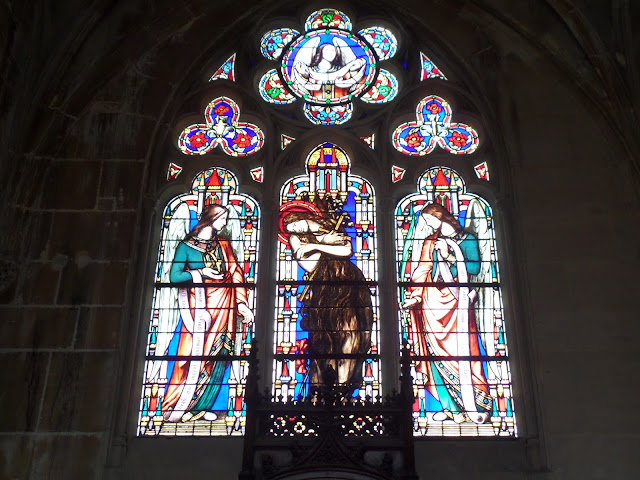
The central panel of this stained glass window depicting Mary Magdalene at St. Germain L'Auxerrois wasn't installed until the 15th century, so Christine wouldn't have know it, but it echoes the 13th century statue of Mary of Egypt on the exterior.
One could spend weeks visiting the churches of Paris. But on previous trips, I was happy to visit only Notre Dame. I’m not interested in the churches in the same way some visitors to France are.  I can appreciate their beauty, but it’s always a challenge for me to know that the stones of the churches were delivered on the backs (literally and figuratively) of the poor.

Even so, churches are at the center of medieval life, and there are a number of churches in Paris where Christine might have worshiped.  We know that she spent time in a small Queen’s Chapel at St. Pol because she writes about the interior decoration with wonder and affection.  On this trip, I wanted to go into the major churches of her time to see what she might have seen.
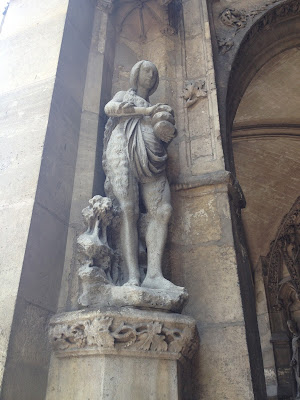
This Mary of Egypt statue was installed in the 13th 
century, so it has stood on the church portal since
before Christine was born. 
I explored a number of churches, and the iconography and stained glass in each was impressive, but walking up to St. Germain L’Auxerrois I got a sense that something about the church was different.  Most churches have Mary somewhere on the portal, but this church had a number of female saints, on some portals there were more female saints than male ones. 

Particularly intriguing was the sculpture of a woman who didn’t seem to be wearing any clothes.  Her body was covered by her sculpted hair. She held a small drape and seemed to be carrying three big stones or loaves of bread.  I’m not Catholic, but I’ve been interested in the Middle Ages for a long time, so I’m familiar with many saints.  This one I did not know.  I was sharing a flat with my friends, both of who are Catholic, but when I asked them later, neither of them were familiar with a naked female saint.

Inside, the images of women continued. Several windows in, I found another naked woman covered only by her hair—no drape, no rounded objects--just hair through which there was a titillating bit of skin around her belly button.

It didn’t take much research to discover that both of the women were named Mary. Both were reputed to be prostitutes before their conversions. It was a regular medieval practice to depict fallen women without their hair, so you may have already guessed that one of these women, the one in stained glass inside, is Mary Magdalene.

The other saint is Mary of Egypt, a prostitute who converted and spent 40 years of penance alone in the desert.  She took only three loaves of bread with her. The only contact with people she had was with a priest before her death who gave her the host and consecrated her burial a year later.
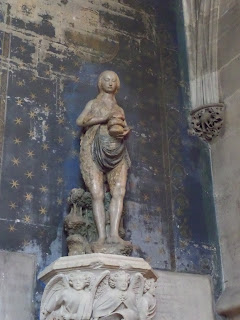
Another Mary of Egypt statue, the background
resembles St. Chappelle, but I'm not sure where
I took this picture.  Anyone know? 
If Christine visited this church, she might have been reminded of, as I was, the particularly conflicted role of women in church culture.  There are many female saints, many depicted in honor on the portals and windows of churches, yet it was a common practice for learned church men to complain, quite loudly, about women’s more sinful natures.

In her argument about The Romance of the Rose and eventually in her City of Ladies and the Treasure of the City of Ladies, Christine brings worthy female models to our attention as an argument against the widespread disregard for women.  Indeed, she mentions both Mary Magdalene and Mary of Egypt in her Treasure of the City of Ladies.

Visiting churches allowed me to read the texts of Christine’s day.  The statues and windows aren’t just ornaments on a medieval church, they are the Bible come to life, the lessons and stories that are intended to guide the lives of God’s people, most of whom would not be  encouraged to read the Bible even if they could. 

The church still maintained strict access to interpretation in the Middle Ages, and with windows and statues they could highlight the stories and values they wanted parishioners to attend to.  These values and stories could be set by the powerful abbotts and clerics who worked with the stone masons and architects to design not just the churches but also their ornamentation.


Wednesday, February 17, 2016

On Failure


Travel is inspiring, but travel for work can be exhausting and
can lead to failure. 
A couple of weeks ago, I talked about how much I loved challenges.  But I wouldn’t have loved them as much eight years ago when I was struggling with perfectionism.

Let me tell you where this is coming from.  I had a great January. Did the work, sent the work out, revised the work.  Showed up!  Hooray.  February has been more of a challenge (but not the good kind).

I love the job that pays my bills.  But, it means I travel long distances (which can be exhausting and disorienting no matter how much I enjoy it).  It means that I am with strangers 6-10 hours a day, which is about 100 percent more time than I usually spend with strangers.  I’m an introvert who needs silence.  When I’m working at my paying job (one or two weeks out of every two months, generally), the hours I write and the hours I gather in are cut back from a strong rope to a slender thread. 

So, in February, though it’s halfway through the month, I’ve only written eight poems.  Since I left for Kenya on Feb. 4, I’ve written fewer than 4,000 words.  Picture books are too bulky to carry, so I haven’t read any.  I have two on my laptop that I downloaded from the library, but I haven’t read them yet.  I have poems that need to be sent out.  I did post date some blog posts before I left, so at least that’s done.  But overall, I’ve failed to meet my goals.

Failed.  For a perfectionist, that's a powerful word.  In the past, failing to write poems from Feb. 5-9 as I did would mean that I wouldn’t write any more poems in February.  Maybe not even for the entire year. 

Here's the photo, taken in Kenya during rush 
hour that inspired my poem "Transfiguration."
This is a type of stork that my taxi driver said 
was only found in downtown Nairobi.  You 
thought geese were bad. 

Not keeping up with my word commitment would mean that I’d probably stop writing for a month or two.  But I’ve learned a lot about myself in the past eight years.  Now I know that just because I don’t always meet my goals , it doesn’t mean I won’t meet my goals.  It just means that I’m having a momentary set back.  I can get back to work on the goal when space (mental or physical) opens up. I can write a poem when I have the energy and quiet to find inspiration.  If I don’t have energy, I can forgive myself, take a walk on the treadmill, or sit by the pool and soak in the world.

Today after a twelve-hour flight across Africa and Europe,  I was sitting in the airport waiting to board my flight back across the Atlantic. I looked at a picture I’d taken on the drive to the airport and wrote a poem.  Though the travel can sometimes get in the way of my work, it also feeds my work. 

I finished a long chapbook last year inspired by my travels (Liminality) that is well on its way to becoming a full-length manuscript.  The book is about the places I’ve seen and by the otherness  and peculiar dislocation of travel. 

Now, on the plane, I’m writing this blog post.  I have free economy plus upgrades, so I have plenty of space for my laptop.  (All the travel I do has other benefits, too.)

I don’t have to meet every challenge I set for myself perfectly.  But challenges keep me moving forward.  Since I’ve learned to forgive myself, to be gentle and patient with myself when I encounter difficulties in my writing practice, I find that it’s easier to come back to the work. 

Note:  One book that really helped me think differently about my perfectionism was The Gifts of Imperfection by Brene Brown.  It's helped me accept my wonderful imperfections (most of the time). 

Friday, February 12, 2016

One Thousand Picture Books

Some of the picture books I read in Jan. 2016.
At the end of January, I accepted a new challenge.  I would read 1,000 picture books in 2016.

I love picture books. Love them. The feel of the pages, their crinkly libarary protective covers, their bigness, their lightness, their words, their pictures.  But I gave them up in 2012 after having written twelve of them.  "Picture books just aren’t selling," said one speaker after another at the SCBWI Northern Ohio conference.  "Well, they sell sometimes," said KidLit’s Mary Kole, "but not very often and not for very much." 

The message was, if you’re trying to get published in the children’s market, don’t bother with picture books. Even if you love them.   So, I put all but two of my manuscripts away and stopped writing them. 

Then, this year, I’ve gotten message after message that picture books are hoppin’ again.  Agents ask picture book writers to send manuscripts (be sure to have more than one).  Publishers list their picture books desires on Manuscript Wish List, more writers seem to be getting agents and contracts. 

So, I’ve decided to go back to an early love and see what’s going on in picture books now.  I signed up for the 1,000 picture book challenge (a subset of the 12 x 12 challenge). In the first pile of books I picked up from the library (I read 82 picture books last week), I found a wonderful biography of Fannie Lou Hammer called Voice of Freedom and it unlocked a possibility for a project I’d been working on.

This morning, I sat down to read ten more.  I’m awed by the sweetness of the vision that writers are bringing to the work, and I love being part of a group of writers who have committed to honing their craft through reading and studying model texts. 


Most of all I’m happy that publishers aren’t shying away from picture books anymore.  Now if I can just find those earlier twelve manuscripts and see if there’s anything worth saving.